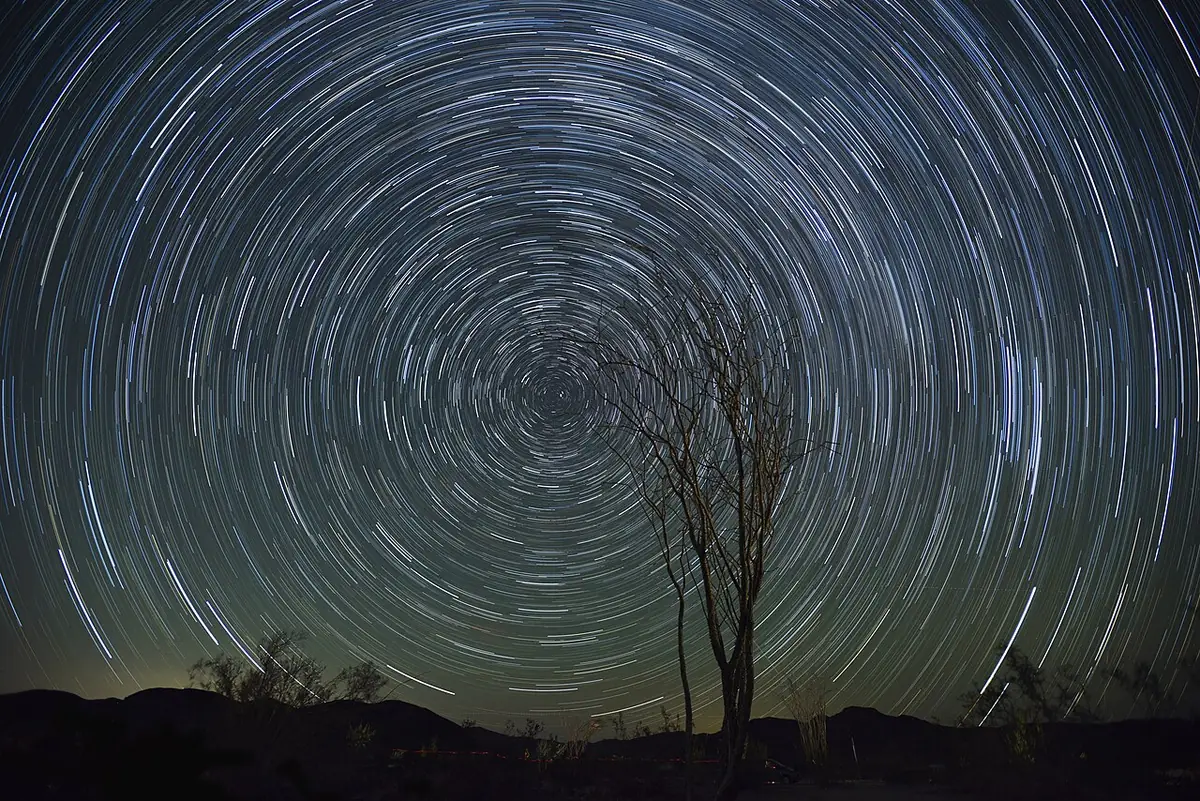
Why stars trail at all
Earth turns once in about 23.93 hours, so the stars appear to turn around the celestial pole. In the Northern Hemisphere that pole is close to Polaris. A camera pointed at the north celestial pole records concentric arcs centred on it, as the Wikipedia article on star trails explains. The Lonely Speck shutter-time calculator article gives the sidereal rate as about 0.0042 degrees per second, roughly 15 arcseconds per second.
Every second of exposure therefore moves a star by a little over 15 arcseconds on the sky, if it sits on the celestial equator. The camera turns that motion into a streak. The question is how many pixels the streak covers.
The 500 rule, written out
The crop factor is the ratio of the 43.3 mm diagonal of a 35 mm frame to the diagonal of your sensor, as the Wikipedia article on crop factor defines it. Check the sensor size in your camera’s specification. A common APS-C crop factor is about 1.5. The Wikipedia astrophotography article uses the same arithmetic in its example: a 35 mm lens on an APS-C sensor gives 500 ÷ (35 × 1.5), about 9.5 seconds. The same article states that the rule holds regardless of aperture or ISO setting.
The limit shrinks as focal length grows because a longer lens magnifies the same angular drift. A star moves the same angle in the sky whatever the lens, but a longer lens spreads that angle over more pixels, so the trail shows sooner.
The table gives the limit for a few common focal lengths.
| Lens focal length | Full frame (crop 1.0) | APS-C style (crop 1.5) |
|---|---|---|
| 14 mm | 35.7 s | 23.8 s |
| 24 mm | 20.8 s | 13.9 s |
| 35 mm | 14.3 s | 9.5 s |
| 50 mm | 10.0 s | 6.7 s |
| 85 mm | 5.9 s | 3.9 s |
Where the rule is too simple
The rule is a guideline, and it leaves out three things that change how visible a trail is.
- Pixel size. The pixel pitch sets the angle each pixel covers. Take a 24 mm lens and a sensor with 6 µm pixels: one pixel spans about 52 arcseconds. An equatorial star moves about 15 arcseconds per second, so the full-frame limit of 20.8 seconds lets it drift about six pixels. Smaller pixels make the same exposure look softer. For the print side of pixel arithmetic, see the pixels, PPI and print size guide.
- Declination. A star’s apparent speed scales with the cosine of its declination, so stars near the celestial pole move slowly and trail less. The Lonely Speck article makes the same point: the closer the camera points to the celestial equator, the more trailing shows at the pixel level.
- Your tolerance. How many pixels of trail you accept is a judgement call. The 500 rule has no input for it.
Fixed tripod or tracker
The 500 rule is written for untracked shots on a fixed tripod. A star tracker or GoTo mount turns the camera against Earth’s rotation, so the untracked limit no longer applies. The astro calculator uses the 500 limit for a fixed mount and its NPF rule for a tracker or GoTo mount. The NPF rule also weighs aperture and pixel pitch, and the calculator shows its working for your settings.
Stacking: how star-trail photos are built
A star-trail photo does not need one very long exposure. Electronic noise grows as exposure time grows, and heat can build up on a single long shot. Photographers therefore often blend many shorter frames, as the Wikipedia article on star trails notes. The limit then applies to each frame, not to the stack.
The hero photo is a stack of this kind. Its file description says it was stacked from frames with a total exposure of about 45 minutes, taken in a very dark part of Joshua Tree National Park. If you print a stacked frame, the image print size tool shows the physical size at the resolution you choose.
When you want point stars
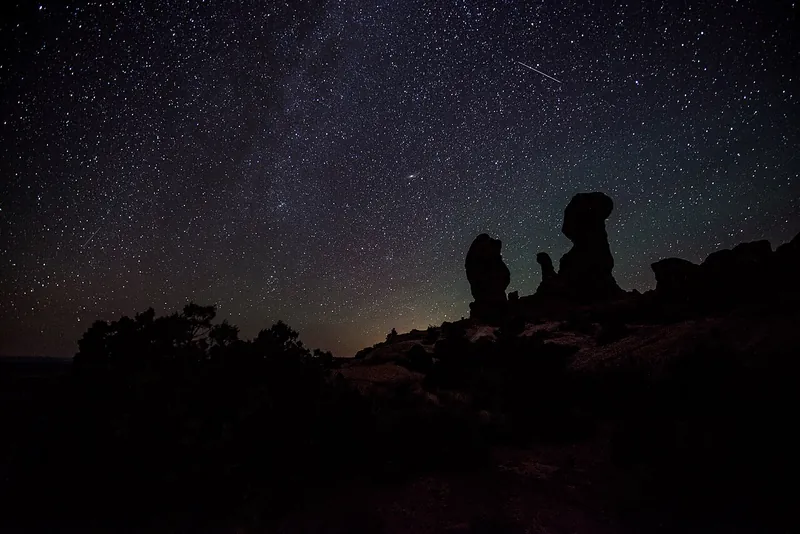
The 500 rule exists to keep stars point-like, which is the look of a wide Milky Way scene. The photo below shows that kind of scene. Its file page does not list the exposure settings, so treat it as an illustration of the goal, not as a test of the rule.
A quick shooting checklist
- Find the actual focal length of the lens you will use, in millimetres.
- Find the crop factor for your sensor. Full frame is 1.0, and about 1.5 is common for APS-C.
- Divide 500 by focal length × crop factor to get a starting limit.
- If the target is near the celestial equator, shorten the frame or stack shorter frames.
- If you use a tracker or GoTo mount, use the tracker limit in the calculator, not the 500 rule.
- For trails, shoot many frames within the limit and stack them, rather than extending one frame.
Common mistakes
- Forgetting the crop factor. On an APS-C camera, a 24 mm lens gives a limit of about 14 seconds, not 21. Using the full-frame figure lets the trails appear.
- Expecting ISO or aperture to change the limit. The 500 rule holds regardless of either setting. A higher ISO brightens the stars but does not lengthen the time before they trail.
- Using the untracked limit on a tracker. A tracker compensates for Earth’s rotation, so the 500 rule no longer describes it. Use the tracker setting in the calculator instead.
- Ignoring the target’s position. A target near the celestial equator trails sooner than one near the pole, so a limit that works in one part of the sky can fail in another.
Before you publish a night-sky photo, check whether its metadata includes a location. The photo metadata remover shows what a file carries, and the EXIF guide explains which fields are risky.
Common questions
Is the 500 rule exact?
No. The Lonely Speck article calls it more of a guideline than a rule. It ignores pixel size and declination, and it has no setting for how much trailing you accept.
Should I use the lens focal length or the full-frame equivalent?
Use the lens focal length in the formula together with the crop factor. A 24 mm lens on an APS-C sensor behaves like about 36 mm on full frame, so the limit is 500 ÷ 36, about 14 seconds.
How do I find my crop factor?
Divide the 43.3 mm diagonal of a 35 mm frame by the diagonal of your sensor. Check the sensor size in the manufacturer’s specification. A full-frame sensor gives 1.0.
Why do stars near the pole trail less?
Stars circle the celestial pole, and a star close to the pole moves on a small circle. The Lonely Speck article gives the arc length as a function of distance from Polaris, so stars near the pole sweep shorter arcs in the same time.
Is stacking the same as one long exposure?
No. Stacking combines many shorter frames, which avoids the heat and noise build-up of one long exposure. The Wikipedia article on star trails describes blending a number of frames as the more practised technique.
Do I need a tracker?
Not for the 500 rule, which assumes an untracked shot on a fixed tripod. A tracker or GoTo mount changes the limit, and the calculator switches to its NPF rule for those setups.
Sources and image credits
- Wikipedia: Astrophotography (the 500 rule formula and example)
- Wikipedia: Star trail (Earth’s rotation, arcs, stacking and noise)
- Wikipedia: Crop factor (definition)
- Lonely Speck: Advanced Astrophotography Shutter Time Calculator (sidereal rate, declination, 500 rule as a guideline)
- Wikimedia Commons: Star Trails over the Ocotillo Garden (public domain)
- Wikimedia Commons: The Milky Way over Garden of Eden (public domain)